
History of Sport in Kyiv: From First Clubs to the 1913 Olympiad
The history of sport in Kyiv goes back to the mid-19th century, and archival documents hold some fascinating details. In 1853 an Austrian subject, K. Schmidt, received permission to teach gymnastics in Kyiv's schools. In 1856 a Prussian subject, K. Wiśniewski, began teaching young Kyivans to swim; in 1859 a Frenchman, F. Lode, opened a gymnastics and fencing school in the city; and the following year Staff Captain Brouns opened a gymnastics and fencing hall "on Khreshchatyk, in the house of the merchant Bagreev."
These foreigners, chasing sensation and publicity, tried to promote their own sporting culture, but they achieved neither mass participation nor wide popularity. The tsarist government did little to encourage or support physical education and sport. The upper classes created closed sports and semi-sports clubs for their own needs, and getting in was not easy: it took recommendations and substantial fees. Among them were the Kyiv Society of Trotting Enthusiasts (1885), the Kyiv Racing Society (1888), the Yacht Club (on Trukhaniv Island, 1887), the Kyiv Chess Society (1900) and the Kyiv Polish Gymnastics Society (1906).

Sport was run by officials who cared little about physical culture, often members of the imperial family and the titled nobility. There was even a post of "Chief Supervisor of the Physical Development of the Population of the Russian Empire," held by General V. M. Voeikov, to whom practically all sports organizations in the country answered. At the end of the 19th century came an important event in Kyiv's sporting life. Inspired by the 1896 Olympic Games in Athens, a group of 23 Kyivans led by the physician Ye. F. Harnych-Harnytskyi adopted the charter of the Kyiv Athletic Society in May 1899. From 1901 it was called the Kyiv Athletic and Gymnastics Society, and later Russian Sokol. Its founder did a great deal for sport in Kyiv: he was harbor master and vice-commodore of the Kyiv Yacht Club, permanent chairman of the gymnastics and athletic societies, founder of the Kyiv Automobile Club, a member of the cycling, tourism and aeronautics societies, chairman of the subcommission on youth physical education of the Kyiv School District, and a frequent lecturer on sport.
Athletes from the Russian Empire first took part in the Olympic Games at the 4th Olympics in London (1908). There were only five of them, but they won one gold and two silver medals. At the 1912 Stockholm Olympics the team numbered 178 athletes. Its rather disappointing performance in Stockholm (16th place) pushed the government to take sport more seriously, and it was decided to hold national olympiads every year to prepare for the international Olympic Games.
A very important role in the development of sport in Kyiv was played by the First All-Russian Olympiad, scheduled to open in Kyiv on August 20, 1913. In 1911–1912, in addition to the existing Orel and Sokol societies and the automobile, aeronautics and tourism societies, the city saw the founding of the Sport club, a tennis club, a cycling track, a sports enthusiasts' circle, the Kyiv Russian Sports Society and the Russian Bogatyr gymnastics society. The Ort and Kašpar factory made gymnastics equipment, and shops sold sporting goods. A Kyiv Olympic Committee was formed of 11 representatives of the city's sports societies, headed by A. K. Anokhin, a physician and gymnastics teacher at the Teachers' Institute; his deputies were Ye. F. Harnych-Harnytskyi and I. Kharzhevskyi, and the secretary was H. H. Kravchuk.

The authorities showed little interest in the needs of sport. Only a modest sum of 10,000 rubles was allocated for the olympiad, and the government's help amounted to the tsar "donating" a prize for the sports society or club that performed best. The Olympic Committee's request for an additional 5,000 rubles was turned down. As a result, the committee had to carry out extensive and difficult preparations to raise extra funds (mainly through voluntary donations from citizens) and to organize the events technically. It asked the authorities to provide free travel to Kyiv for all participants, asked gymnasium directors to house student athletes, and asked doctors to help with medical examinations and provide care when needed. The committee invited all the country's sports societies and representatives of the army. The first to agree were Kyiv's sports organizations, army units and a military school.
Finally, a venue was chosen. On the outskirts of the city, in Lukianivka, between Lvivska (today's Sichovykh Striltsiv Street), Hlybochytska and Dyka Streets, there had once been an orchard with empty lots beyond it. The owners cut down the trees and turned the land into a paid skating rink for local boys, the so-called Sports Field. It was this site that became the olympiad's main arena. The story of this first permanent stadium in Kyiv is an interesting one. The lack of a stadium had held back sports such as football, since Kyiv could not host teams from other cities. In 1912 a group of eight enthusiasts formed a shareholding company and leased two desiatinas of land in Lukianivka from the landowner F. M. Yasnohurskyi for ten years. Here, between Dyka, Fylypivska and Monastyrska Streets, they built the Sports Field stadium, modeled on the Parc des Princes in Paris. It had steep stands with 1,000 seats, open stands with benches for 1,750 spectators, and standing room for another two thousand. This first permanent sports ground in Kyiv was designed for football, track and field and cycling, as well as speed skating and motorcycle racing. The Sports Field was formally opened on Sunday, August 12, 1912.

The stadium was decked with flags, and every stand was packed. Many fans without tickets perched in trees, on fences and on the roofs of nearby houses. The opening ceremony was accompanied by two military bands and a choir conducted by P. H. Honcharov. Competitions in various sports began, but the main event of the day was undoubtedly the football match between a Czech team and players from the Kyiv Sport club. It ended in a 0–0 draw, and the celebration closed with a grand fireworks display. The stadium's later fate was sad: the Sports Field burned down during World War I. In the summer of 1913, the final preparations for the olympiad were under way.
On July 13, 1913, at the office of the notary A. M. Boborykin (27 Khreshchatyk), the Olympic Committee signed an agreement with the shareholding company to lease the Sports Field. Final work began on the stands, cycling track, running tracks and gymnastics equipment; medals, badges and diplomas were prepared for the winners. A commemorative badge was made for the olympiad, showing a discus thrower with the inscription "PRO 1913" (the abbreviation of First Russian Olympiad). 
The olympiad opened on August 20, 1913. Overall, its results were rated quite highly, and it was called a dress rehearsal for the Berlin Olympics planned for 1916. Many records were set, something unprecedented for sport in the empire at the time. Kyiv's own athletes performed successfully and achieved notable results.
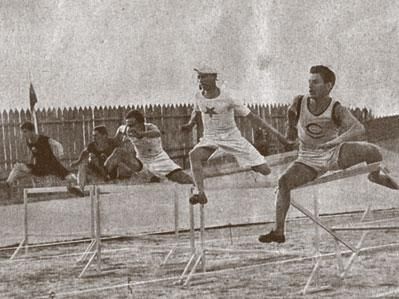
The olympiad spurred further growth of sports organizations, especially in Kyiv. In September 1913 the city saw the opening of the Sportsmen's Club, the Society for the Promotion of Physical Development and Sport, and the sports club of Alekseevsky (Trukhaniv) Island.
On May 11, 1914, a large sports festival involving all the city's sports organizations was held at the Pechersk Hippodrome. The money raised went toward preparing Kyiv athletes for the Second All-Russian Olympiad, held in Riga in 1914 with almost 1,000 athletes from 24 cities. The outbreak of World War I disrupted it: the competitions were held in haste and wrapped up quickly. With that, an entire era in the history of sport in the region came to an end.


