
Askold's Grave

A park on the Dnipro slopes where, the chronicle says, Prince Askold was buried: Andrii Melenskyi's Empire rotunda, a lost cemetery and the graves of today's fallen soldiers.
The legend of Askold
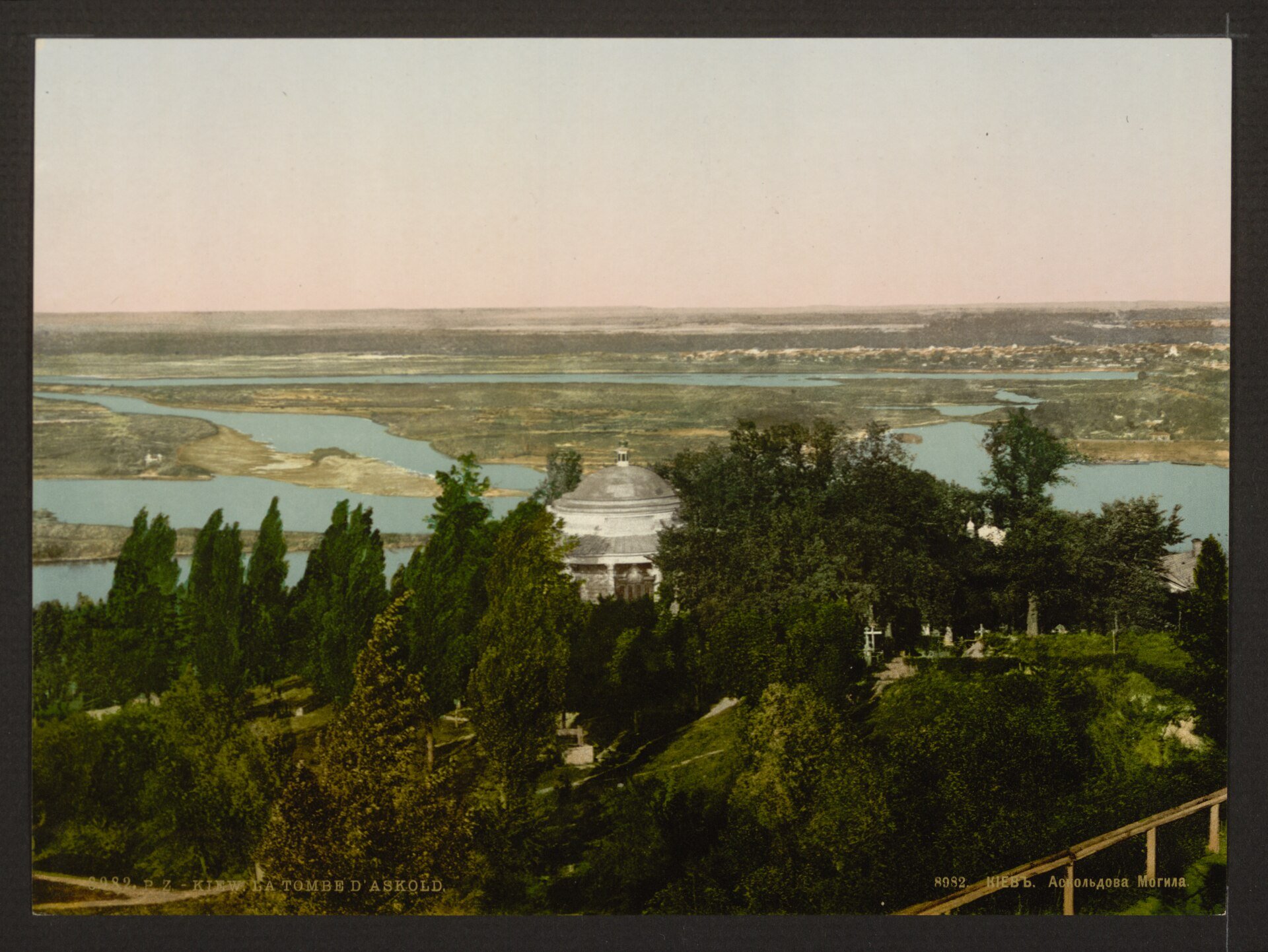
According to the Primary Chronicle, in 882 Prince Oleh of Novgorod lured the Kyivan princes Askold and Dir to the bank of the Dnipro and killed them. Askold was buried "on the hill now called Uhorske", where Olma's court and a church of St Nicholas later stood. Uhorske, where the Magyars were said to have camped on their way to the Danube, has been identified with this slope above the Dnipro since the 18th century. That is why the church of St Nicholas came to be seen as standing on Askold's grave, the prince supposedly having been baptised as Nicholas. Whether he really lies here is unknown. The name Askold's Grave was fixed in the 19th century, helped along by Mikhail Zagoskin's novel and Alexei Verstovsky's opera.
By the 15th century at the latest, the Pustynno-Mykilskyi Monastery stood on the slope. In the late 17th century Hetman Ivan Mazepa built it a large new cathedral on the hilltop, and most of the monks moved up there. Down below remained a wooden St Nicholas church and the monastery cemetery.
Melenskyi's rotunda
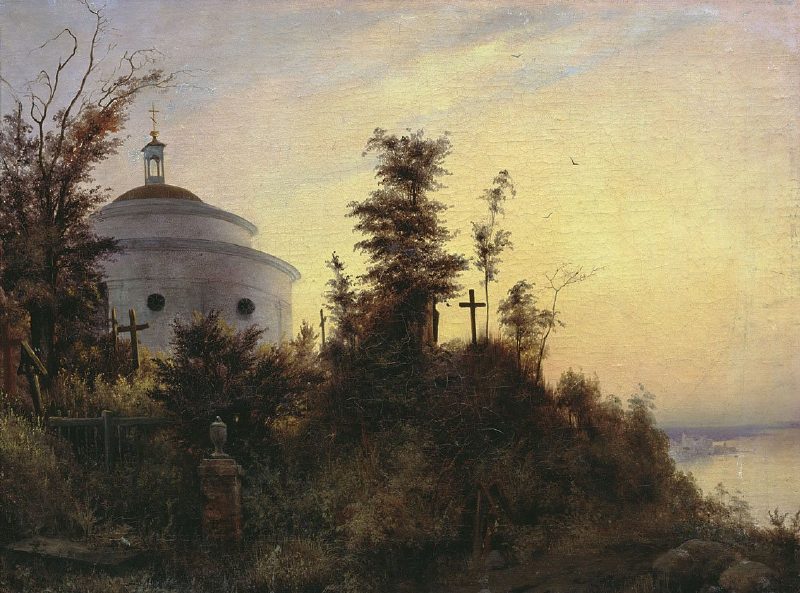
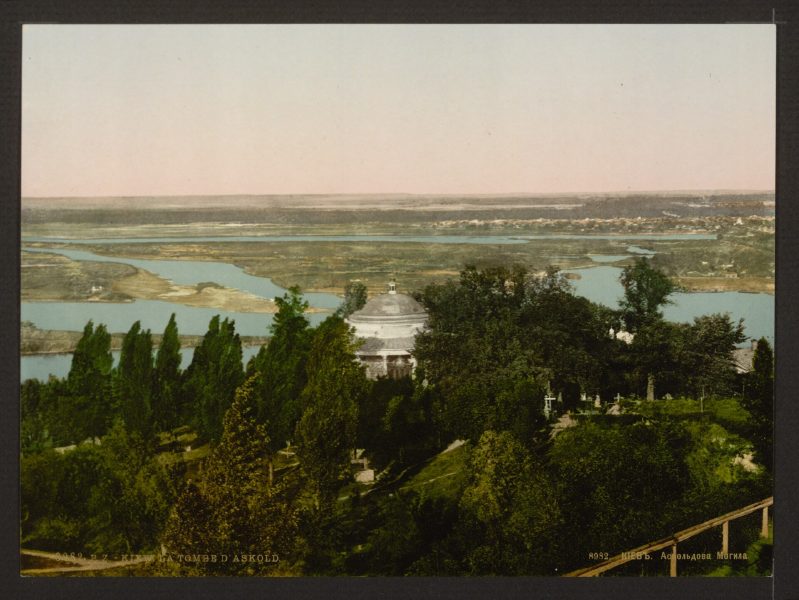
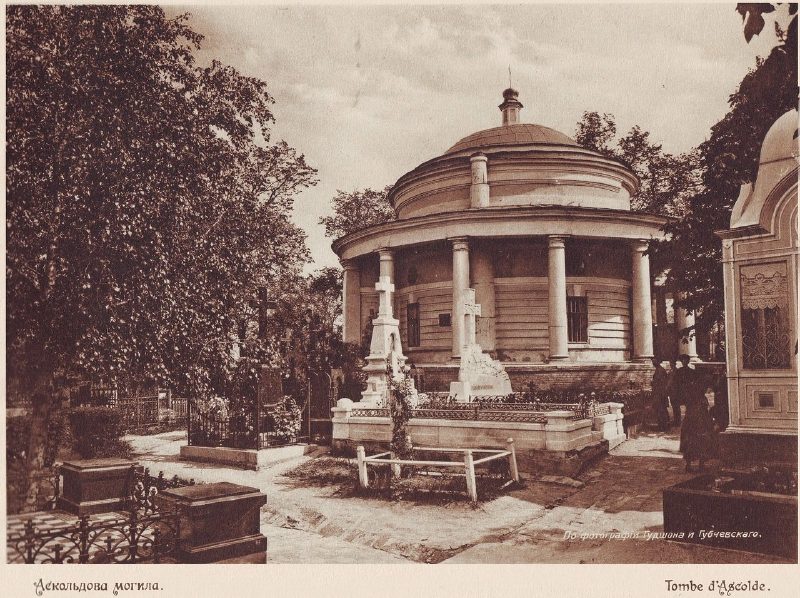
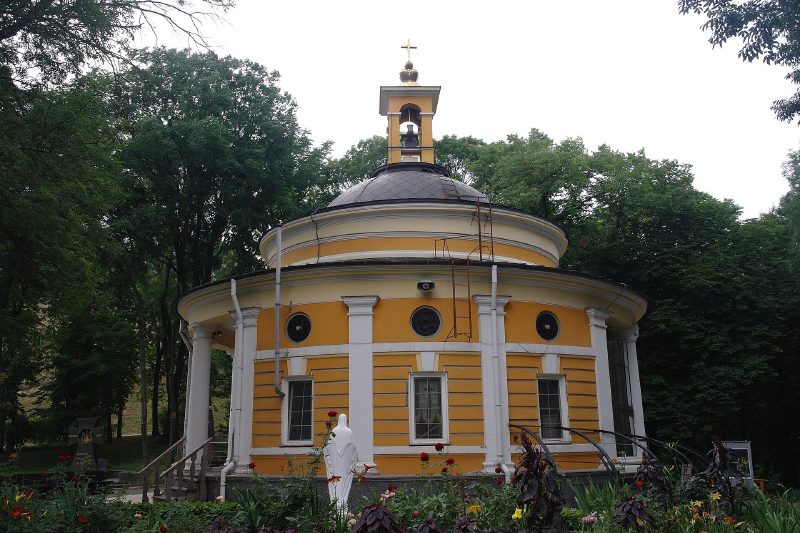
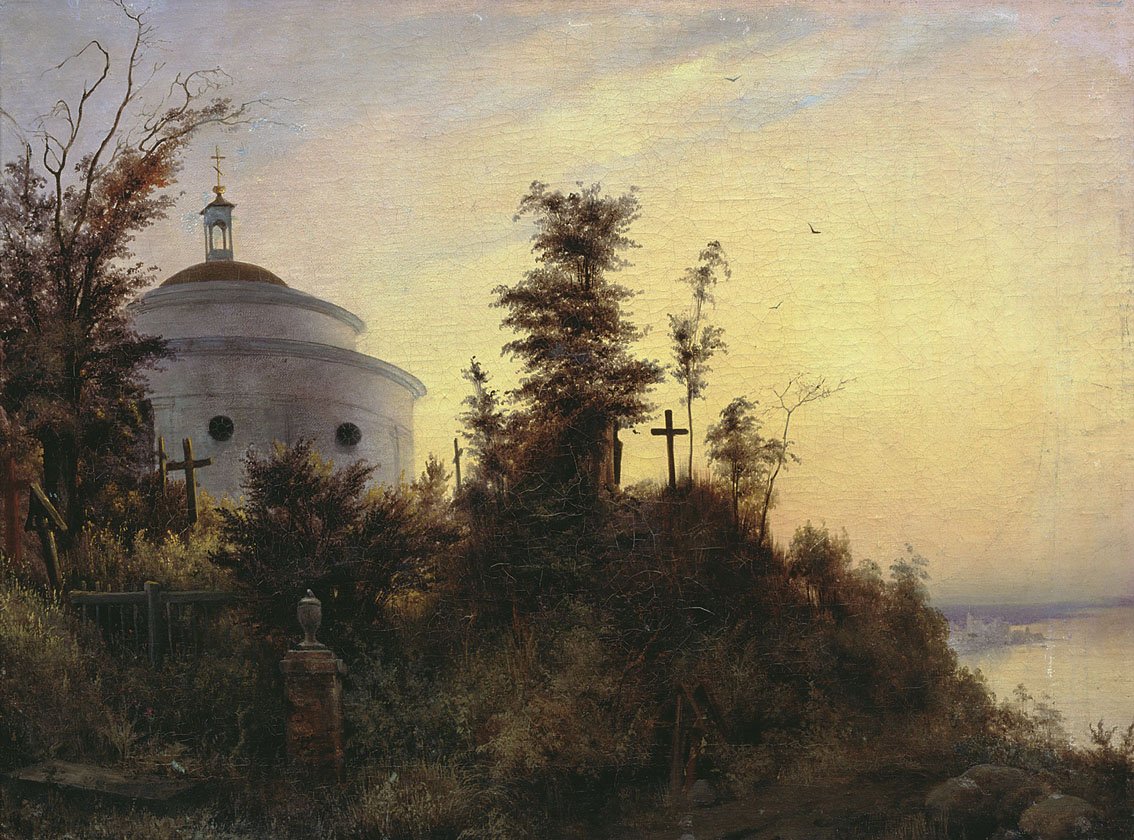
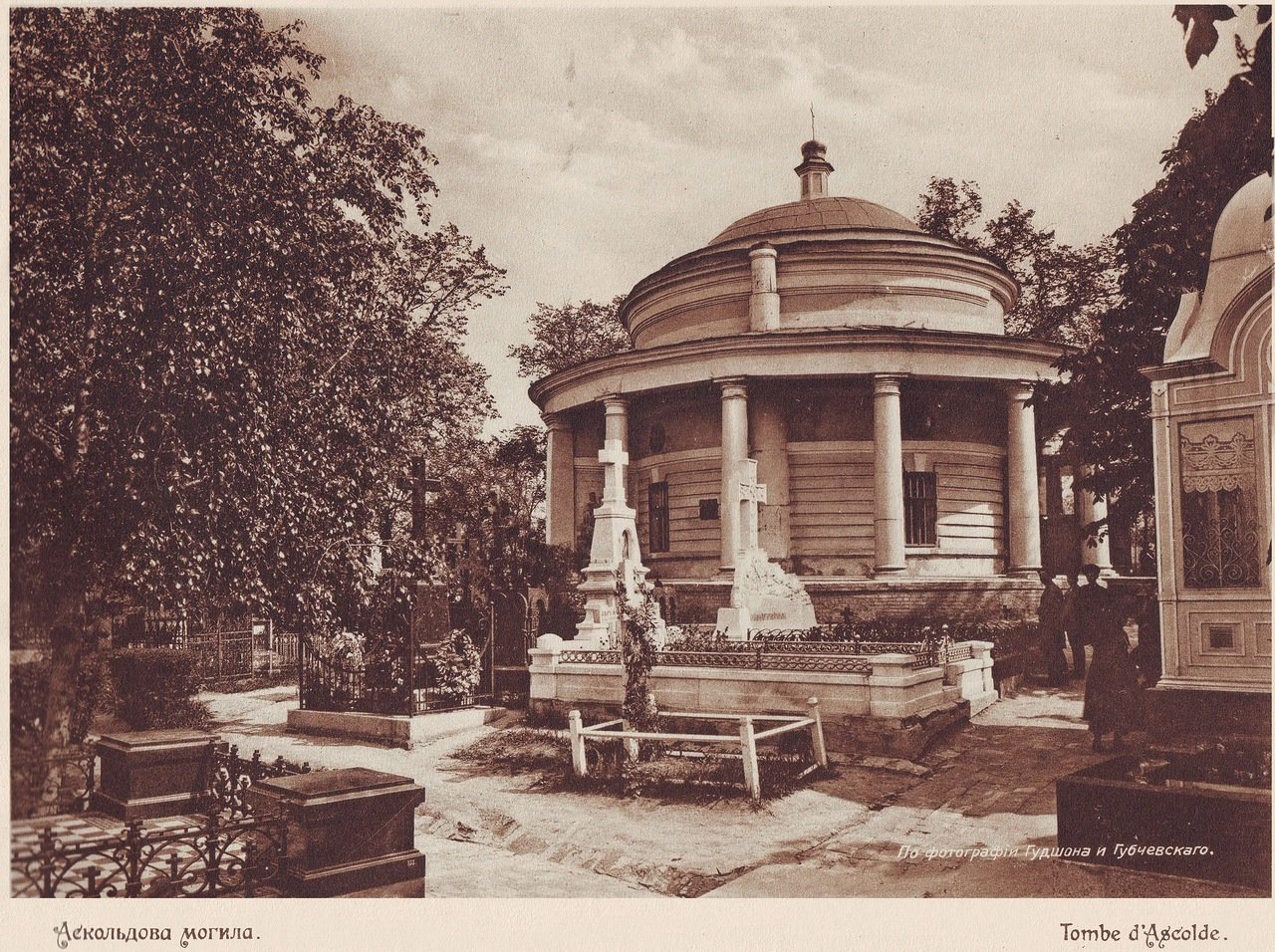
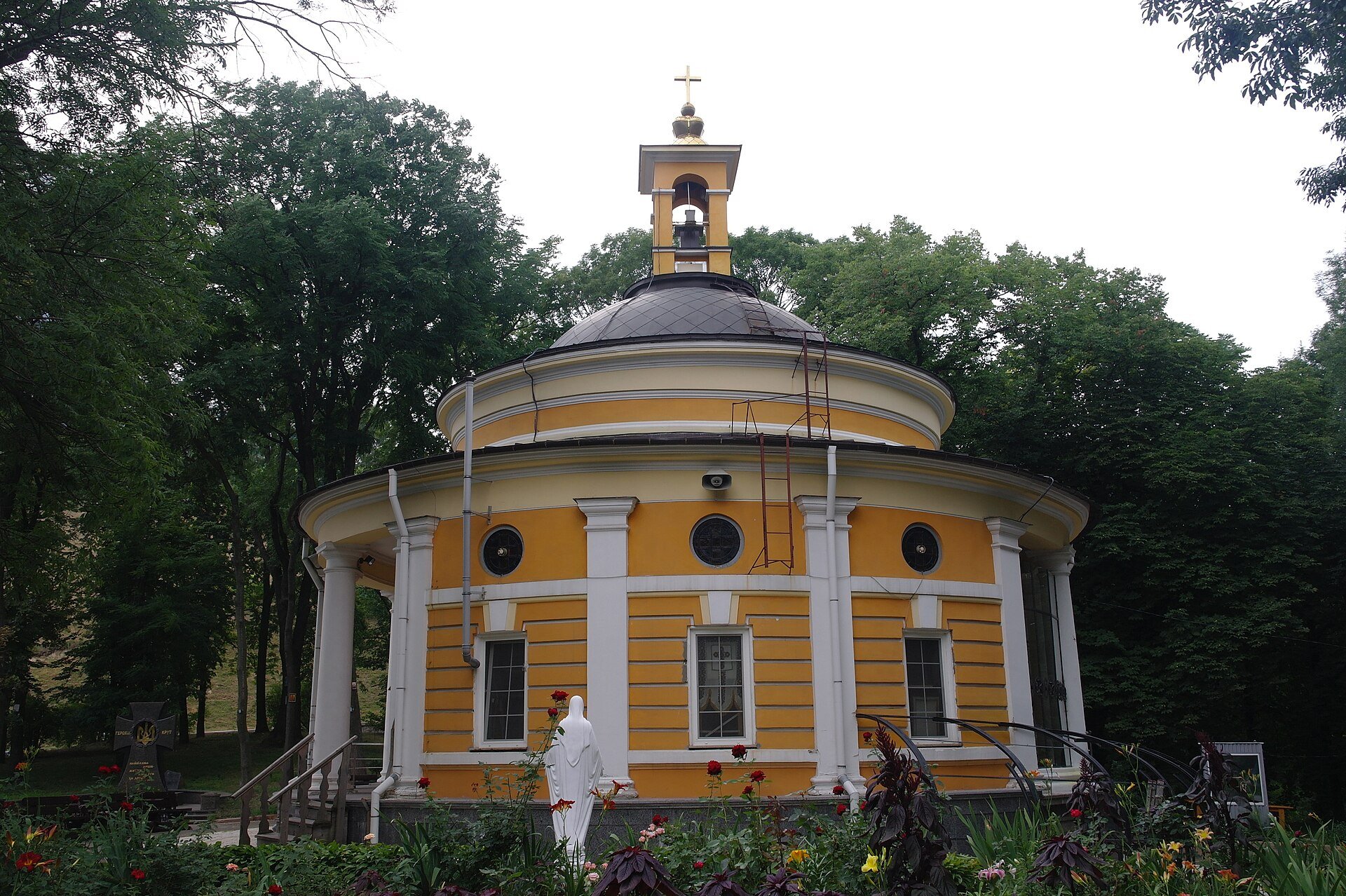
The present church was built in 1809 by Samiilo Meshcheriakov, a merchant from Voronezh, in memory of his wife, who was buried at Askold's Grave. It was designed by Andrii Melenskyi, the city architect behind much of classical Podil. He produced a small two-storey Empire rotunda ringed by Tuscan columns, with a low dome and a lantern, and it was consecrated on 1 September 1810. A crypt for burials was built into the half-sunken lower level. In 1847 the church and cemetery were due to be cleared for the road to the new Chain Bridge, but Emperor Nicholas I inspected the church and ordered it to be repaired and kept.
A cemetery that is gone
In the 19th and early 20th centuries Askold's Grave was one of Kyiv's most prestigious cemeteries. Professors and doctors, actors and merchants were buried here, as were soldiers from veterans of 1812 to the aviator Pyotr Nesterov, killed in 1914. The patron Vasyl Tarnovskyi and the theatre founder Mykola Solovtsov lay here alongside bankers and factory owners. In March 1918 the students and schoolboys killed in the Battle of Kruty were solemnly reburied on the slope.
The Bolsheviks closed the cemetery in 1919 and began clearing it in 1934. Vaults and headstones were destroyed, and only a few graves were moved, among them Nesterov's to Lukianivka Cemetery and Solovtsov's to Baikove. In 1936 the church was turned into a restaurant, and in 1938 the architect Petro Yurchenko converted it into a park pavilion, replacing the dome with an open Ionic colonnade. The bell tower and fence were pulled down at the same time. This was the origin of the Soviet park, and until the late 1990s Kyivans knew the building simply as "the rotunda".
A church restored and new graves
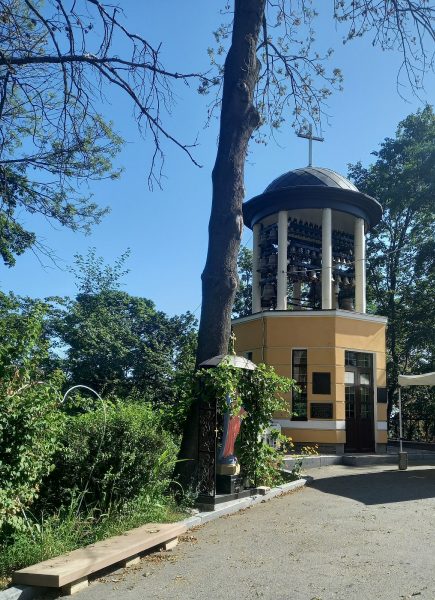
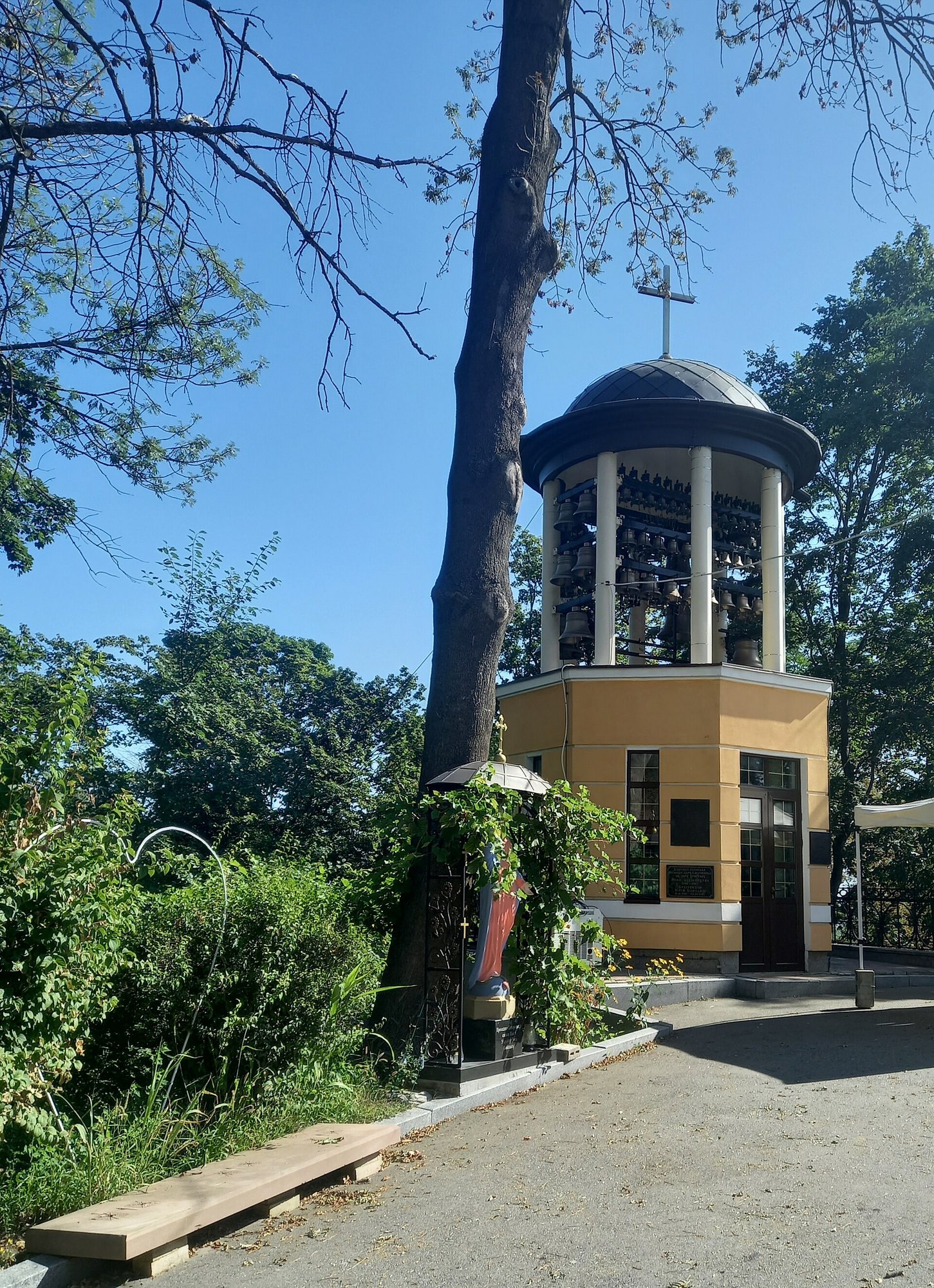
In 1992 the church was handed to a parish of the Ukrainian Greek Catholic Church. In 1997–1998 it was restored to its original form to a design by Volodymyr Khromchenkov, and in May 1998 it was consecrated by Lubomyr Husar, then the church's exarch in Kyiv. On 23 June 2001 Pope John Paul II came here to pray at the start of his visit to Ukraine. In 2016–2017 the parish built a new bell tower with 51 bells next to the church. A cross on the slope honours the heroes of Kruty, and near the entrance a memorial marks 1,100 years since the Magyars passed Kyiv.
Since 2014 Askold's Grave has again become a burial place. Here lie Oleksandr Klitynskyi, one of the Heavenly Hundred of the Maidan, Marko Paslavskyi of the Donbas battalion, Dmytro Kotsiubailo, commander of the Da Vinci Wolves battalion, the military pilot Andrii Pilshchykov and the activist and soldier Pavlo Petrychenko. A 2023 petition to create a National Pantheon of Heroes here gathered the required 25,000 signatures, but no official decision has followed. In practice, Askold's Grave has already become a place to remember those killed in the Russian-Ukrainian war.
Visiting
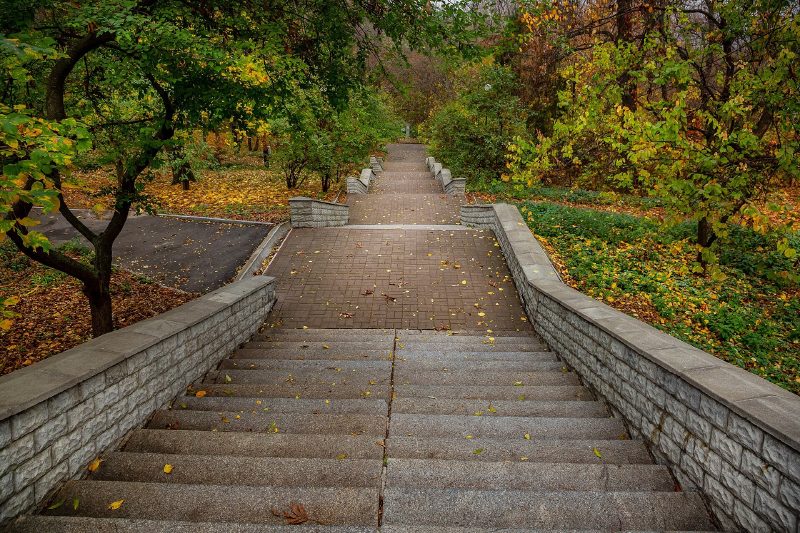
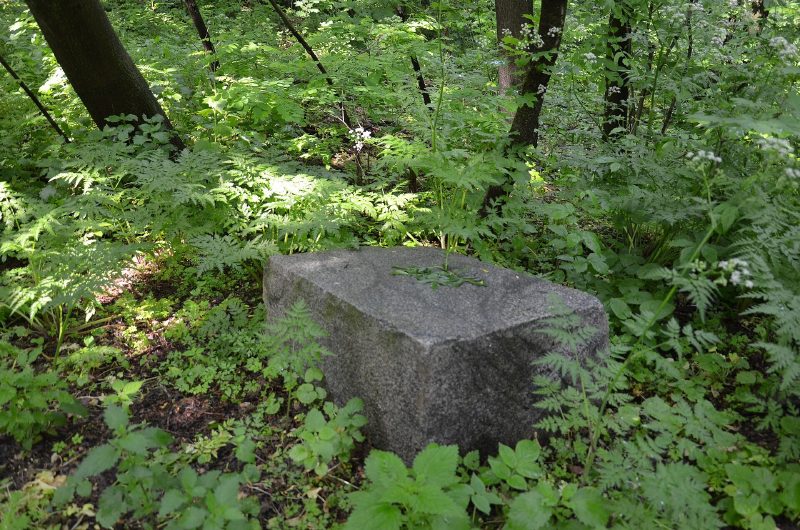
The park covers steep slopes between Dniprovskyi Uzviz, Ivana Mazepy St and Mariinskyi Park. An avenue leads from Parkova Road up to the rotunda, and paths wind higher up with views over the Dnipro. Near the church you can still find a few fragments of old headstones and the only surviving family vault, now a chapel. Please be respectful at the soldiers' graves, where relatives and comrades come every day.
People and eras

Photo gallery · 7 photos
Through the years
-
-
-
-
-
-
-
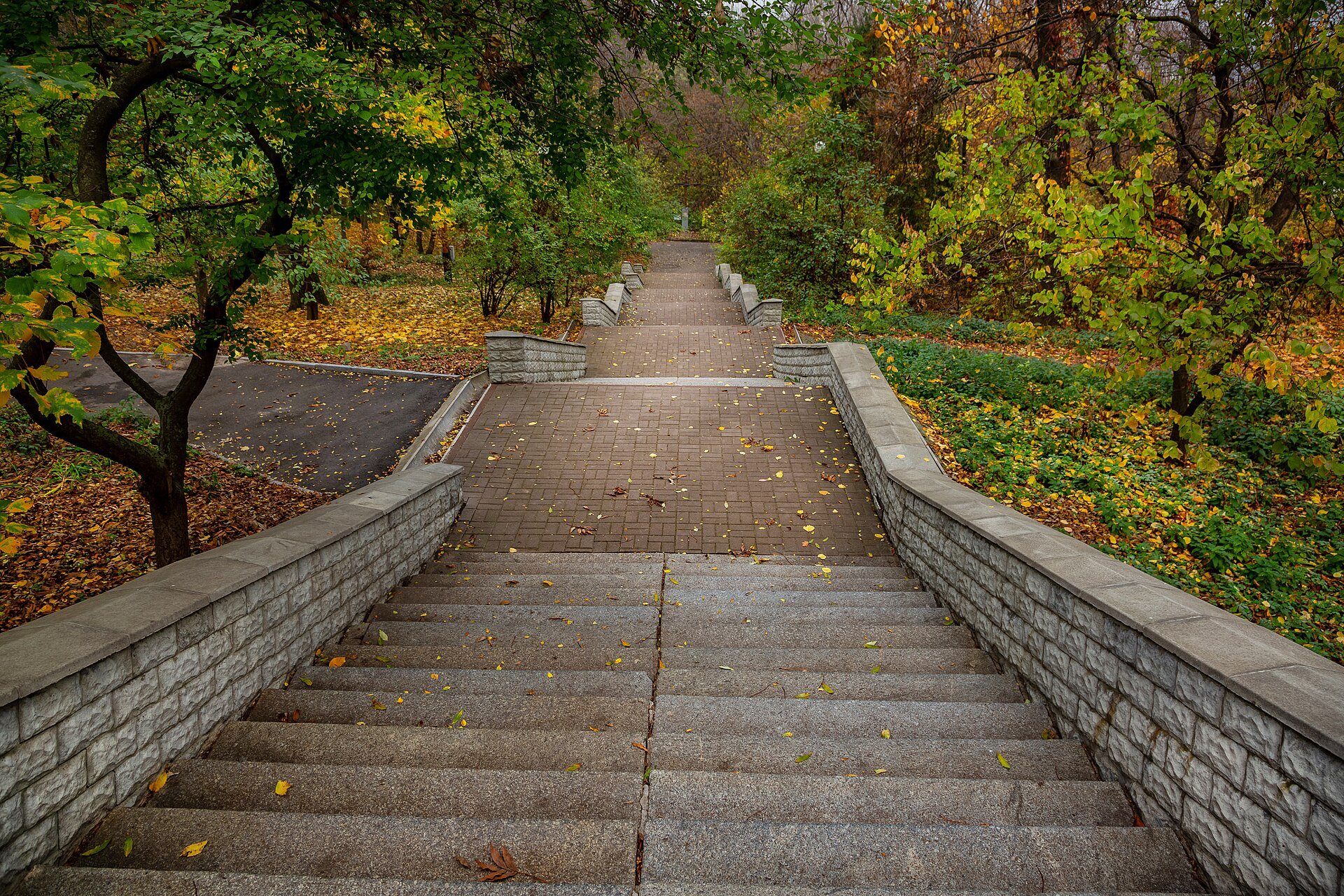
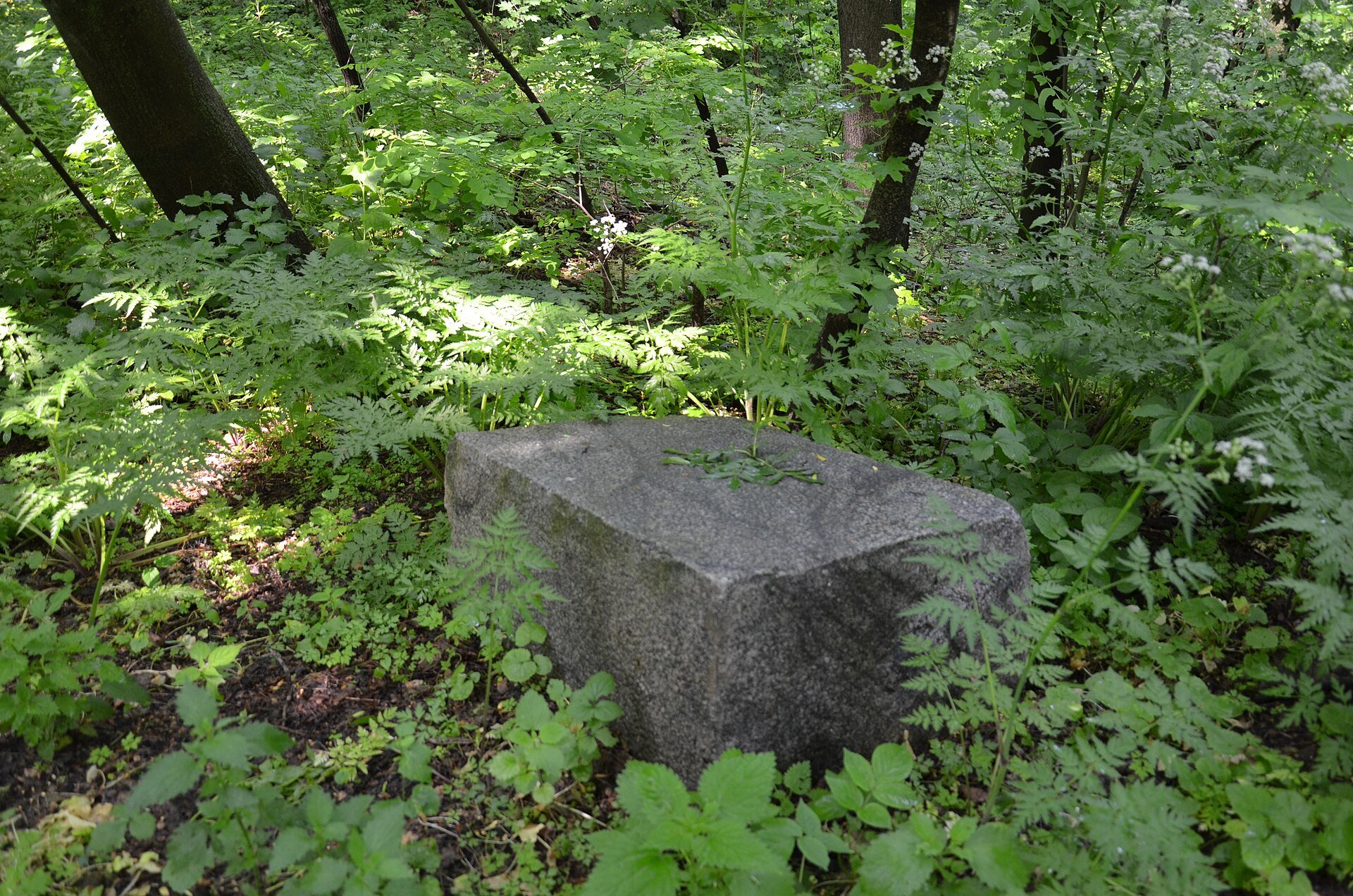
Then and now
Compare yourself
Drag the slider to see how the place has changed.
Slider


Photo overlay
Video
Askold's Grave on screen
Аскольдова могила: легенди та факти — КИЇВ24 | Телеканал Київ · YouTube


Guide
Similar places
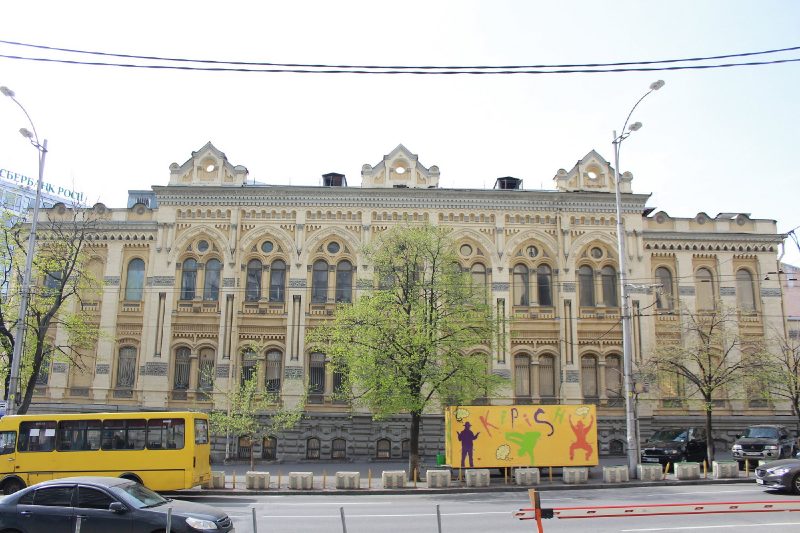 Brodsky Choral Synagogue in Kyiv: History and ArchitectureThe Brodsky Choral Synagogue on Shota Rustaveli Street opened in 1898. Discover how it was built through a clever trick, lost in Soviet times and reborn.
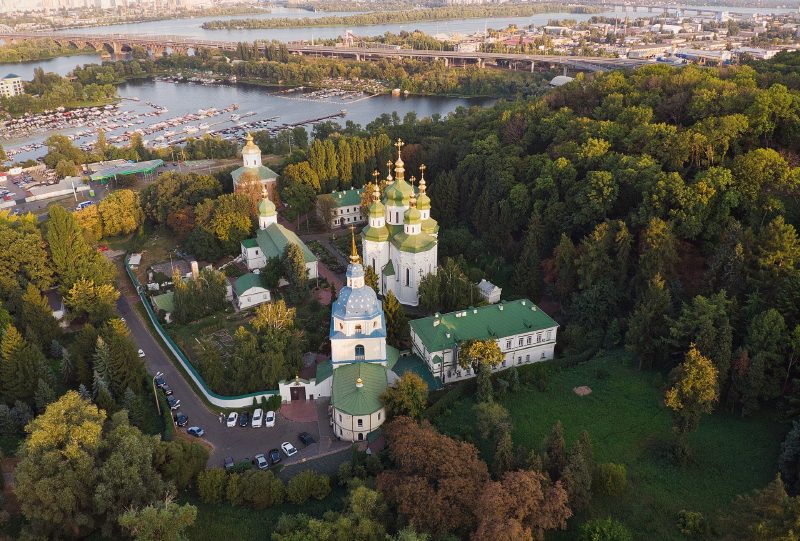 Vydubychi MonasteryA monastery founded by Prince Vsevolod above the Dnipro in 1070, with the 11th-century St Michael's, the Baroque St George's Cathedral and the Botanical Garden's lilacs next door.
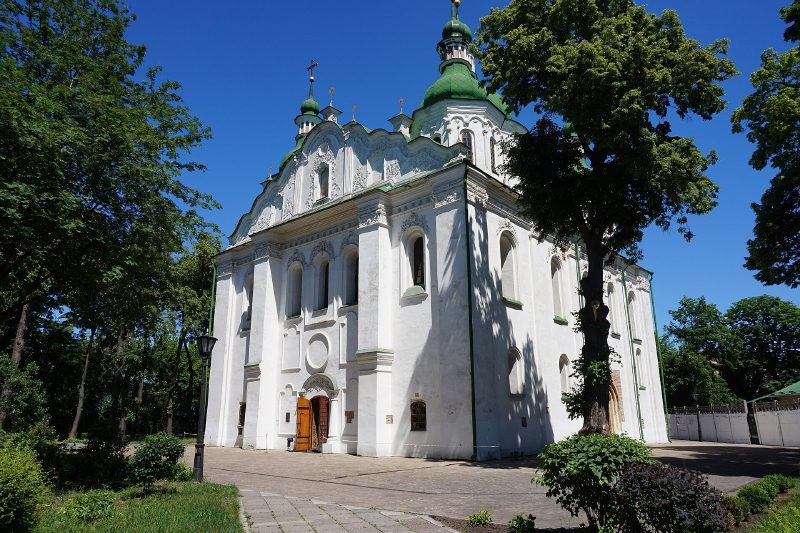 St Cyril's ChurchA 12th-century church at Dorohozhychi, burial place of the Olhovych princes, with Baroque façades by Hryhorovych-Barskyi, medieval frescoes and murals and icons by Mikhail Vrubel.


