
What Kyiv Looked Like 100 Years Ago, Part 1

Without knowing our history, we cannot build our future. It is a simple truth every thoughtful person learns. And you don't have to dig through old books and archives to find historical details that shed light on the past: sometimes it is enough to look at the old photographs kept in your grandparents' albums. They are sure to show places that disappeared long ago. Here we look at ten photographs of Kyiv taken in the late 19th and early 20th centuries. Perhaps you will spot something in them you never noticed before.
Polytechnic Institute

The renowned architects Ieronim Kitner and Oleksandr Kobelev designed this campus. The institute opened in 1898, and the list of its successful alumni could fill a whole book. Among the most famous names associated with the Kyiv Polytechnic are Yevhen Paton, Borys Paton, Serhii Korolov, Ivan Bardin, Oleksandr Vinter and many other scientists.
Bessarabska Square
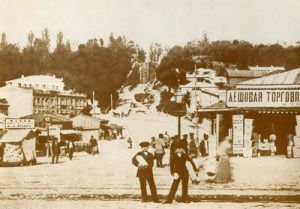
At the end of the 19th century, Bessarabska Square was a favorite spot for small private businesses: bakeries, smithies and market stalls opened here. In 1910, construction began here on a covered market designed by Henryk Gay, which would later become known as the Bessarabskyi Market.
Volodymyrska Street

This is how Volodymyrska Street looked at the beginning of the last century. Its buildings showed features of classicism, set by the architectural style of the university itself and echoed by the buildings that followed.
St. Volodymyr's Cathedral
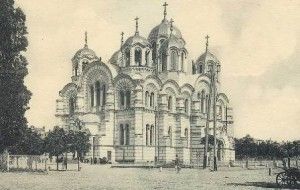
One of Kyiv's best-known Orthodox cathedrals, built with the participation of many outstanding 19th-century architects and artists. The first design, in the Neo-Byzantine style, was the joint work of Ivan Shtrom and Pavel Sparro. The cathedral was later redesigned by architect Oleksandr Beretti and engineer Rudolf Bernhard, who found a way to reinforce the facade walls. Construction was supervised by architect Volodymyr Nikolaiev. The interior murals, painted between 1885 and 1896, are of great value; artists such as Viktor Vasnetsov, Mikhail Nesterov, Pavel Svedomsky and Wilhelm Kotarbinski took part in creating them.
Sofiivska Street

This street connected two squares: Sofiivska Square (long known as Bohdan Khmelnytskyi Square) and Khreshchatyk Square, today Maidan Nezalezhnosti. In the distance stood the Institute for Noble Maidens on Ivanivska Street (today Instytutska Street). This closed school educated girls of noble birth, who after graduating could work as governesses for the children of noble or merchant families. In 1852, the Institute also began admitting the daughters of honorary citizens and first-guild merchants.
Horodetskoho Street

In the early 1900s, on this street, then called Mykolaivska, Krutikov's Hippo-Palace circus was built on the site of the later Ukraina cinema. It occupied two floors and could seat 2,000 spectators. Many Russian and international stars performed here, including Feodor Chaliapin and Titta Ruffo. Next to the circus stood the Hotel Continental, where many artists stayed, among them Vladimir Mayakovsky. Sadly, both buildings were destroyed in 1941.
Khreshchatyk

By the early 20th century, Khreshchatyk had already earned its title as Kyiv's main street. It was lined with hotels, cinemas, the post office, pharmacies, offices, shops, banks and restaurants. A key difference from today's Khreshchatyk is that a tram ran along the old street, and its buildings were much lower.
Bibikovskyi Boulevard

Bibikovskyi Boulevard is one of the former names of Taras Shevchenko Boulevard, which in the 19th century was also known as Shosseinyi and Universytetskyi. It was named after Taras Shevchenko only in 1919, and the name has stuck for good.
Kinna Square

Today this is European Square, but in the early 19th century it was home to a horse market, which is how it got the name Kinna (Horse) Square. In May 1892, the first electric tram in the Russian Empire was launched here.
Pavlo Galagan College

This private school for young men was built in 1870 by architect Alexander Schille, commissioned by the well-known Ukrainian public figure and patron Hryhorii Galagan. The school was named in memory of Hryhorii's late son, Pavlo, and opened in 1871. Many prominent scholars graduated from it, among them Oleksandr Bohomolets, Volodymyr Hrabar, Mykhailo Drai-Khmara, Hryhorii Kostiuk and Nestor Kotliarevskyi. After the revolution of 1917, the college was closed.
Of course, old photographs cannot fully convey the era in which they were taken. But they do let us catch a glimpse of a part of history we may never have known before!


